
The Cricket Triangle: A Structural Reading of Formats, Markets and Governance
यह लेख किसी विशिष्ट मैच, खिलाड़ी या श्रृंखला की रिपोर्ट नहीं है, बल्कि क्रिकेट की संरचनात्मक अर्थव्यवस्था का विश्लेषण है। मुख्य बिंदु: (1) क्रिकेट के तीन प्रारूप — टेस्ट, एकदिवसीय और टी20 — के आँकड़े एक-दूसरे के पर्याय नहीं हैं; बिना प्रारूप-लेबल के कोई आँकड़ा अर्थहीन है। (2) खिलाड़ी-आकलन भूमिका-पहचान, युग-समायोजन, स्थितिगत विभाजन, लय-प्रवृत्ति, आयु-वक्र और चोट-इतिहास के ढाँचे से होना चाहिए, न कि केवल औसत से। (3) टीम की वास्तविक ताकत रैंकिंग नहीं, बल्कि बेंच drop-off और आयु-संरचना से मापी जाती है। (4) क्रिकेट दो समानांतर अर्थव्यवस्थाओं में बँटा है — राष्ट्रीय टीम और लीग; आईपीएल केंद्र में है, और लीग-विंडो तथा कार्यभार-प्रबंधन उनके बीच स्थायी तनाव हैं। (5) वैश्विक क्रिकेट राजस्व भारी रूप से भारतीय बाज़ार पर केंद्रित है, जो एक संरचनात्मक एकाग्रता-जोखिम है। (6) शासन-स्तर पर डीआरएस/अंपायर कॉल, डीएलएस पद्धति और धीमी ओवर-दर स्थायी विवाद हैं; सत्यनिष्ठा निगरानी अब मैदान से अधिक संचार-चैनलों पर केंद्रित है। (7) 2028 लॉस एंजिल्स ओलंपिक में टी20 के शामिल होने से नया बाज़ार और वित्तपोषण-धारा खुलेगी, पर कैलेंडर पर दबाव बढ़ेगा। (8) क्रिकेट-कवरेज की सबसे आम त्रुटियाँ: अल्पकालिक प्रदर्शन को दीर्घकालिक कथा बनाना, लीग-प्रदर्शन से अंतरराष्ट्रीय सफलता का पूर्वानुमान, और अपेक्षा-अंतराल को मापे बिना मूल्यांकन करना। अस्वीकरण: यह सामग्री केवल खेल-सूचना संदर्भ के लिए है, किसी सट्टेबाज़ी सलाह के रूप में नहीं; खेल-परिणाम अत्यधिक अनिश्चित होते हैं।
Cricket is the only major team sport in which three fully valid international formats run in parallel: five-day Tests, 50-over ODIs, and 20-over T20s. This parallelism is not merely a scheduling constraint — it is the foundation of the sport's entire economic and administrative architecture. One player, one board, one broadcast deal and one fan base must serve three different products whose success metrics, audience demographics, revenue intensity and time horizons are fundamentally different.
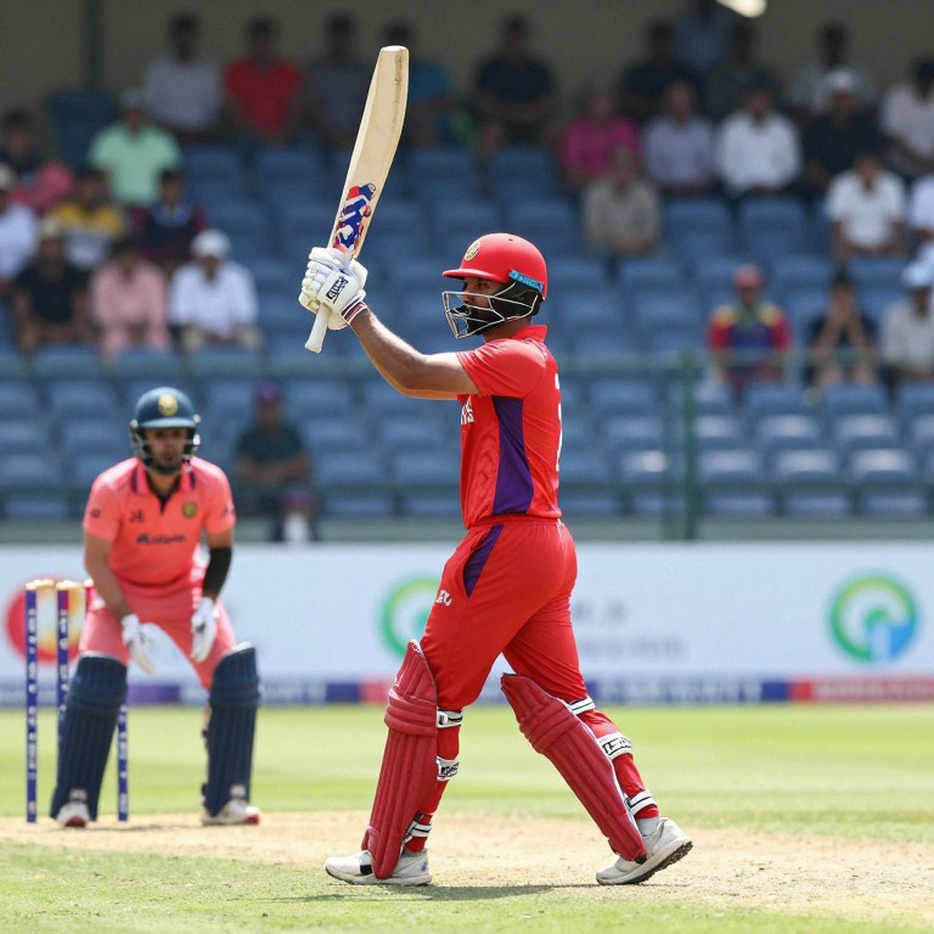
This piece is not a report on a specific match, series or player. It is a structural reading of the framework within which every individual cricket statistic, selection decision, auction bid and broadcast deal acquires meaning. Its purpose is to clarify why the most common analytical errors in cricket coverage occur — and why they are avoidable.
Format incompatibility: the first and largest fault line
Test cricket rewards average over strike rate; an opener who grinds out 40 across five sessions is more valuable in Test logic than one who makes 45 off 25 balls. In T20 the relationship inverts: strike rate and economy rate are primary, average secondary. ODI is not a convenient middle ground but has its own internal logic — a ten-over powerplay, a middle-overs consolidation phase, and a final ten-over explosion. Since 2026, the use of two new balls changed ODI structure: less reverse swing, a different role for spinners in the middle, more difficulty at the death. T20 restructured the game further into a three-block template — six-over powerplay, middle squeeze, death overs — and innovations such as the Impact Player rule in the IPL altered team-balance mathematics by reducing the cost of carrying a specialist.
Statistical noise also differs by format. T20 offers a small number of deliveries per innings, so a single match or short series is a weak sample. Five good games labelled 'a return to form' is a statistically fragile claim. Tests generate more data points per match but fewer matches, so sample-size problems persist there too.
A framework for player assessment
Assessment must begin with role classification, not averages: opener, anchor, finisher, pace bowler, spinner, all-rounder, keeper-batter — each has a distinct evaluation scale. An anchor's value lies in balls consumed and wickets preserved; a finisher's in death-overs strike rate. Comparing them on a single strike-rate table is a category error. Era adjustment is essential because the game changes collectively — pitches, bats, fielding restrictions, mentality. Situational splits — home versus away, spin-friendly versus seaming conditions, batting position, new ball versus old ball — reveal what aggregate averages hide. Trend matters more than career baseline, provided format and opposition quality are held constant. The age curve differs by role: fast bowlers peak earlier, spinners later and for longer. Injury history and workload, especially for all-format all-rounders, can outweigh raw numbers. And the most important caveat of all: small-sample conclusions. Two strong T20 league seasons do not guarantee international success, and two poor series do not end a player's capability.
Team landscape beyond rankings
Team assessment operates at three levels. The formal level — ICC rankings, World Test Championship points, table position — is an average that conceals home-away differences. The second level is therefore the home/away profile and stylistic adaptability. The third is organisational depth: batting depth is not merely who bats at seven but how many runs a side can post when the top three fail together; bowling combination means whether a team has separate specialists for the new ball, middle overs and death; bench drop-off measures how far performance falls when a key player is injured, and is the most honest indicator of real strength. Age structure is a longer-horizon dimension — a side with five key players approaching retirement within the same two-year window carries structural risk regardless of current ranking. Finally, stylistic matchups — subcontinental technique against bounce and swing, footwork against spin, left-arm pace against right-handed top orders — are real historical patterns that must be re-tested each series rather than treated as permanent laws.
Leagues and the commercial ecosystem
Cricket now runs two parallel economies: the national-team economy, built on broadcast rights, sponsorship and ICC revenue distribution; and the league economy, built on franchise valuation, player salaries, ticketing and digital engagement. They nourish and compete with each other simultaneously. The IPL sits at the centre. Since 2026 it has reshaped player income (league contracts now rival or exceed central contracts), the calendar (an April-May window is now a permanent structural element), and technique itself, rewarding specialisation — death-over specialists, powerplay specialists, spin-hitters — with no direct international equivalent.
The league commercial model rests on three pillars: media rights (the largest revenue component, valued on viewership, advertising rates and digital engagement), franchise valuation (a market estimate of durable brand value), and player salaries via auction. The IPL auction is a unique economic structure: a capped purse, retention rules and the Right to Match mean the highest bidder does not always win, and outcomes are well beyond 'the richest team wins'. The fundamental tension line is league versus national team — over time (overlapping windows), workload (injury probability rises steeply for all-format, multi-league players), and administrative control (No Objection Certificates and central-contract discipline). The global spread of leagues — SA20, ILT20, CPL, PSL, BBL, MLC — shares one economic logic: supply cricket in the months the IPL does not. The consequence is that empty space in the international calendar has become a resource, and boards now compete not only for players but for windows. The WPL's significance is more structural than commercial: it creates a durable professional pathway that strengthens the lower end of the talent supply chain.
Governance, rules and disputes
Governance operates at three levels — ICC, national boards, leagues — with authority boundaries that have never been fully clear. The most contested structural legacy is revenue distribution: the 2026 'Big Three' model gave India, Australia and England privileged shares, drawing sustained criticism from smaller members. Later cycles revised the model but the underlying imbalance persists, because global cricket's commercial revenue is heavily dependent on the Indian market — and that dependence is reflected in governance too. It shapes which series happen, which format gets priority, and how the international calendar is built.
At the playing-rules level, three disputes are permanent. DRS and 'umpire's call' is a compromise between technological assistance and umpiring authority, producing outcomes where the same delivery can be judged differently depending on how far inside the stumps the ball was tracking. The Duckworth-Lewis-Stern method is unavoidable yet contested every time a side loses under it. Slow over-rate penalties now range from fielding restrictions to match fees and often affect outcomes. Integrity is more sensitive still: major match-fixing and spot-fixing cases permanently changed cricket's governance, creating a standing anti-corruption unit and mandatory reporting obligations — while the challenge has shifted from the field to messaging services, betting apps and informal channels. Eligibility and contract discipline generate recurring friction between player autonomy and board control, with no universal solution because each board's finances and player pool differ. Geopolitical factors directly shape the calendar: some bilateral series do not happen for years for political reasons, and the hosting of multi-nation events remains contested — decisions that are not cricket-based but affect competitive balance, since a team that does not play at a venue never builds a record there.
A newer and more positive governance development is cricket's return to the Olympics, with T20 included at Los Angeles 2028. Its significance is not merely an extra tournament: it opens a new geographic market and a new funding stream, but also brings a new window obligation into an already congested annual calendar.
The risk picture
Six risk areas matter. Sporting risk is the most visible — injury, form decline, loss of format-specific specialisation — with a less-discussed dimension: the limits of technical transfer between formats. Personnel risk — coaching changes, selection committee turnover, leadership transitions — matters but is hard to measure; the largest personnel risk is usually the least visible: the steady loss of experience as senior players depart one by one. Commercial risk arrives as falling rights values, sponsorship downturns and franchise cash-flow pressure; its most sensitive point is that global cricket revenue is heavily concentrated in one market, so any downturn there transmits across the whole system — a concentration risk for which no effective structural mitigation yet exists. Rules and integrity risk covers betting-related threats, irregular contact and information-sharing violations, made more complex by changing communication channels. Public-opinion risk is volatile and amplified by social media: one bad innings, one contested selection or one umpiring call can become a global argument within hours, pushing boards and selectors toward short-term sentiment management rather than long-term strategy. Systemic risk is the most neglected and most serious: calendar saturation can reach a point where audience interest declines because no single match feels important; and a narrowing talent pipeline — if the league system rewards only established players — reduces lower-level investment and creates a supply crisis a decade later.
Narrative and the expectation gap
Cricket coverage builds narrative before fact. Standard archetypes recur: the rivalry showdown, the dynasty's rise or fall, the coronation of a new star, the veteran's farewell, the redemption arc. Each contains a kernel of truth and each carries an exaggeration risk. The most common error is converting short-term performance into long-term narrative: two good innings become 'a comeback', two poor ones 'a crisis', when statistically most of this is ordinary variance. The second error is extrapolating league performance to international level — high T20 league strike rates do not transfer automatically, because bowling quality, pressure levels and the depth of opposition analysis differ. The third is failing to measure the expectation gap: no performance can be evaluated without knowing what was expected, and if the expectation was unreasonable, the failure is in the expectation, not the performance. Making that distinction explicit may be cricket analysis's most useful contribution.
Industry transmission
Cricket's economy is a three-tier transmission chain. Upstream sits youth development and talent supply — domestic cricket, under-19 systems, regional academies. Midstream are national teams and leagues, converting that talent into product. Downstream are broadcast, digital media, sponsorship, derivative markets and the fan economy. The weakest link is upstream, because returns arrive years later and are hard to measure; league-based models often incentivise immediate results, pushing youth development down the priority list — yet the whole industry's long-term capacity is set by the quality of that top tier. The South Asian market is the centre of the chain not only in audience numbers but in revenue generation, which gives the sport a stable financial base but leaves the entire system dependent on a single market cycle. The broadcast landscape is shifting: traditional television rights still matter, but digital rights are gaining share, which affects not only revenue split but product design — clips, short-form and second-screen experiences reshape how matches are presented. Derivative markets — fantasy sports, data analytics, sports technology, content creation — are a growing share of cricket's economic impact, creating new access routes alongside regulatory complexity, particularly where the boundary between betting and fantasy is disputed. Emerging markets raise an open question: whether MLS-style and Olympic-linked investment can establish cricket durably in markets without deep cultural roots. Historically such efforts have had limited success, and the real test is not initial enthusiasm but locally generated talent supply a decade later.
Conclusion
Any cricket event occurs simultaneously on three planes — format (technical and statistical), governance (boards, ICC, rules) and market (broadcast, leagues, talent value). Most cricket analysis stops at one plane, which is why it remains incomplete. Three principles help: the necessity of format context, since any statistic without a format label is meaningless; honesty about sample size, since drawing large conclusions from small samples is cricket analysis's most common ailment and the only cure is admitting when a question cannot yet be answered; and the separation of process from outcome, since a good process sometimes loses and a bad one sometimes wins. Cricket's future rests on three questions: whether format balance holds or T20's commercial pressure squeezes the others; whether revenue concentration eases or deepens; and whether investment in the talent supply chain survives commercial pressure. All three remain uncertain — and that uncertainty is what will keep cricket coverage interesting.